There’s a particular moment every home theatre owner remembers: the lights dim, the opening score swells, and the room disappears. That’s not an accident of good luck — it’s the result of deliberate engineering, careful acoustic planning, and componentry chosen to work together rather than simply sit side by side.
Australia’s appetite for premium home entertainment has grown sharply over the past decade. New builds increasingly set aside a dedicated room for cinema-grade sound and picture, renovators are converting underused spaces into media rooms, and architects are being asked to plan for AV infrastructure from the earliest design stages. Yet despite this growing interest, misinformation is everywhere — from inflated speaker counts to screens that are the wrong size for the room, to acoustic treatment being bolted on as an afterthought rather than designed in from day one.
This guide exists to cut through that noise. Whether you’re a homeowner comparing quotes, a builder scoping a new project, an architect drafting plans, or a renovator weighing up what’s realistic on your budget, you’ll find genuinely practical guidance here — not marketing fluff. We’ll walk through what a home theatre actually is, how it differs from a home cinema or media room, the technology that makes Dolby Atmos work, how to choose a screen or projector, where speakers belong, why acoustic treatment matters as much as the gear itself, and what realistic costs look like in the Australian market in 2026.
As a Melbourne-based specialist in luxury home theatres, home automation, and premium AV installation, Kyte Tech has built and commissioned home theatre systems across Victoria for architects, builders, and homeowners who expect the result to feel effortless — even though very little about getting there is.
Let’s start with the fundamentals.
Table of Contents
- What is a Home Theatre?
- Benefits of a Home Theatre
- Home Theatre vs Home Cinema vs Media Room
- Essential Components of a Home Theatre
- Dolby Atmos Explained
- Choosing the Right Screen or Projector
- Speaker Types and Placement
- Acoustic Treatment
- Lighting Design
- Seating Design
- Wiring and Future-Proofing
- Smart Home Integration
- Typical Home Theatre Costs in Australia
- Common Mistakes Homeowners Make
- Why Professional Installation Matters
- Why Choose Kyte Tech
- Frequently Asked Questions
- Conclusion
What is a Home Theatre?
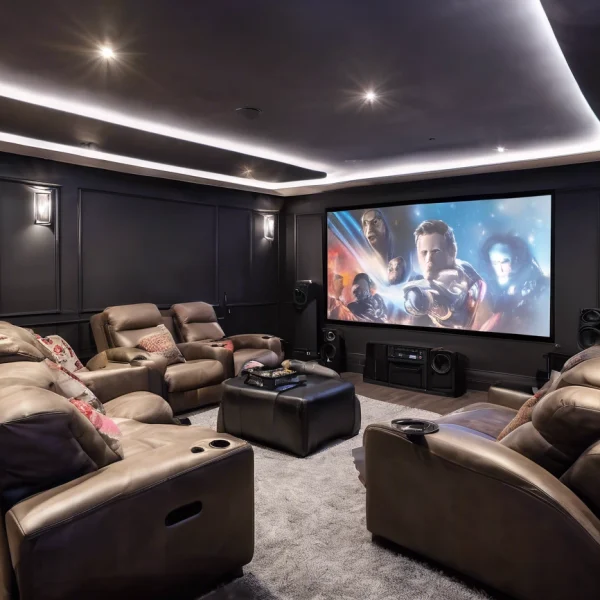
A home theatre is a purpose-built room, or purpose-configured space, designed to replicate — and in many cases exceed — the audio and visual experience of a commercial cinema. It combines a large-format display (typically a projector and screen, though large-format TVs are increasingly used), a multi-channel surround sound system, controlled lighting, acoustic treatment, and comfortable, tiered seating, all engineered to work together as a single system rather than a collection of separate devices.
The defining feature of a true home theatre isn’t the size of the television or the number of speakers in the room — it’s intentional design. Every element, from wall construction to cable routing to seat spacing, is planned around the viewing and listening experience.
A home theatre typically includes:
- A dedicated or semi-dedicated room, often with minimal external light
- A projector and acoustically transparent screen, or a large premium display
- A multi-channel surround sound or Dolby Atmos speaker system
- Acoustic treatment on walls, ceiling, and floor
- Tiered or riser-based seating for unobstructed sightlines
- Programmable lighting and shading
- Centralised control via a smart home system or universal remote
Benefits of a Home Theatre
A well-designed home theatre delivers value well beyond movie nights. Here’s what homeowners consistently tell us matters most.
- Immersive entertainment on demand — no bookings, no crowded car parks, no shared armrests.
- Family connection — a dedicated space that draws the household together for films, sport, and gaming.
- Property value — a professionally installed home theatre is a genuine point of difference in the luxury property market, particularly in Melbourne’s premium suburbs.
- Superior audio and picture quality — properly calibrated systems outperform even the best soundbar-and-TV combination by a wide margin.
- Entertaining and lifestyle appeal — a media room or theatre becomes a natural hub for hosting sport, gaming nights, and family gatherings.
- Long-term flexibility — a room wired and structured correctly today can be upgraded with new technology for years without re-renovating.
It’s worth noting that “resale value” claims should be treated with a healthy dose of realism — a theatre adds appeal and differentiation, but its value is best measured in lifestyle terms first and property terms second.
Home Theatre vs Home Cinema vs Media Room
These terms are often used interchangeably in Australia, but they describe meaningfully different spaces. Understanding the distinction helps you set the right budget and expectations from the outset.
Home Theatre
A dedicated room, generally windowless or blacked out, purpose-built for critical viewing and listening. Expect tiered seating, full acoustic treatment, and a projector-and-screen setup. This is the highest tier of investment and the highest tier of experience.
Home Cinema
Often used synonymously with “home theatre” in Australia, though some professionals use “cinema” to describe a slightly more theatrical or design-led aesthetic — think cinema-style wall sconces, curtains, and a more decorative finish alongside the technical build.
Media Room
A multi-purpose living space — often open-plan or semi-open — that includes a large screen and quality sound system, but doubles as a family room, games room, or casual lounge. Media rooms are more budget-flexible and don’t require full acoustic isolation, but they also can’t match the immersive ceiling-to-floor experience of a dedicated theatre.
Quick guide:
| Feature | Home Theatre | Home Cinema | Media Room |
|---|---|---|---|
| Dedicated room | Yes | Yes | Often shared/open-plan |
| Light control | Full blackout | Full blackout | Partial |
| Seating | Tiered, cinema-style | Tiered, cinema-style | Sofa/lounge |
| Acoustic treatment | Extensive | Extensive | Light to moderate |
| Typical budget | Highest | High | Moderate |
There’s no wrong choice here — the right option depends on how the space will be used day to day, and how much of the home you’re willing to dedicate to it.
Essential Components of a Home Theatre
A genuinely great home theatre is a system of interdependent parts. Missing or under-specifying any one of them compromises the whole.
1. Display: Projector or Large-Format Screen
The heart of the visual experience — covered in detail below.
2. Audio System
Multi-channel surround sound, ideally with height channels for Dolby Atmos, powered by a dedicated AV receiver or processor and amplifier.
3. Source Equipment
Media players, streaming devices, gaming consoles, and Blu-ray players, plus signal distribution equipment if content needs to reach multiple zones.
4. Acoustic Treatment
Absorption and diffusion panels, bass traps, and sometimes structural soundproofing.
5. Seating
Tiered risers, cinema recliners, or bespoke lounges with clear, unobstructed sightlines to the screen.
6. Lighting Control
Dimmable, scene-based lighting that shifts from “movie mode” to “conversation mode” at the touch of a button.
7. Control System
A single interface — app, remote, or wall-mounted touch panel — that brings the whole room together.
8. Cabling and Infrastructure
Structured, future-proofed cabling that supports today’s technology and tomorrow’s upgrades.
Dolby Atmos Explained – Home Theatre
Dolby Atmos is the current benchmark for immersive home audio, and it’s one of the most misunderstood terms in the industry.
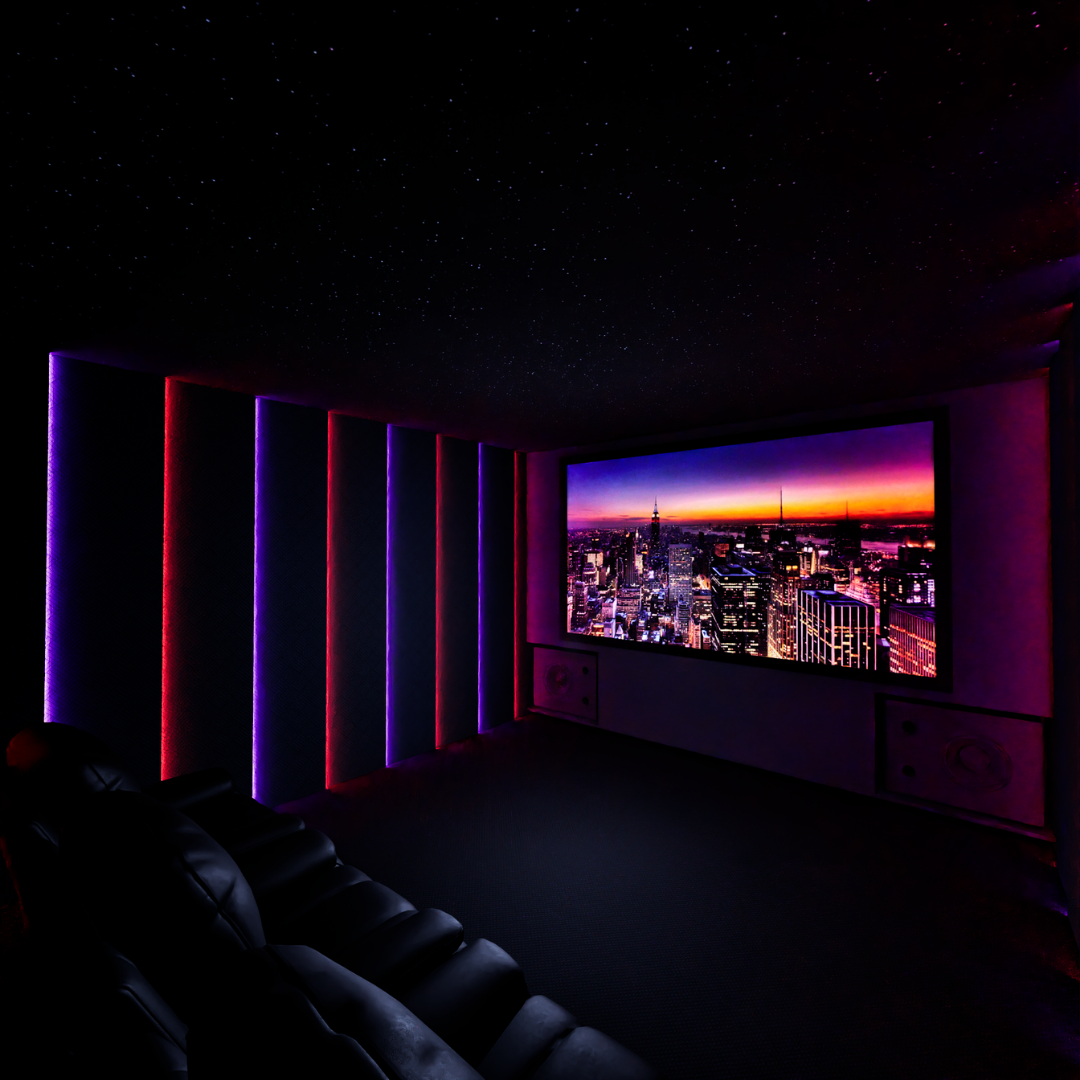
Traditional surround sound (5.1, 7.1) treats audio as fixed channels — front left, front right, centre, surrounds, subwoofer. Dolby Atmos changes this by treating sounds as individual “objects” that can be placed and moved anywhere in three-dimensional space, including overhead. Rain can fall from above you. A helicopter can pass directly over your seat rather than simply from left to right.
How it works in practice:
- Height channels are added via in-ceiling speakers or upward-firing modules that bounce sound off the ceiling.
- A common configuration is 7.1.4 — seven surround channels, one subwoofer channel, and four height channels.
- Atmos is object-based, meaning the same soundtrack can adapt intelligently to different speaker layouts.
Common myths about Dolby Atmos:
- “You need dozens of speakers.” Not true — a well-designed 5.1.2 or 7.1.4 system, correctly placed and calibrated, will outperform an oversized system that’s poorly configured.
- “Atmos only matters for action films.” In reality, well-mixed Atmos tracks enhance music, ambience, and dialogue clarity across almost all genres.
- “Soundbars can do Atmos properly.” Soundbars can decode Atmos and create a virtual impression of height, but they cannot replicate genuine overhead imaging the way discrete in-ceiling speakers can.
For most Australian homes, we recommend planning ceiling speaker locations at the framing stage — retrofitting height channels into a finished ceiling is possible, but significantly more costly and limiting.
Choosing the Right Screen or Projector
This is one of the most consequential decisions in the entire build, and one where “bigger” isn’t automatically “better.”
Projector vs Large-Format TV
Projectors remain the preferred choice for dedicated, light-controlled theatre rooms. Benefits include:
- Larger image sizes (100″–180″+) at a proportionally lower cost per inch than TVs
- A more authentic “cinema” aesthetic
- Acoustically transparent screens that allow speakers to sit directly behind the picture
Large-format TVs (particularly OLED and MicroLED) suit media rooms with ambient light, or theatres where daytime use is a priority. Benefits include:
- Excellent contrast and brightness, even with some ambient light
- No bulb replacement or throw-distance requirements
- Instant-on convenience
Key considerations
- Room size and seating distance — screen size should be matched to the distance of the furthest seat, not the size of the wall.
- Ambient light control — projectors demand near-total light control to perform at their best.
- Native resolution — 4K is now the baseline; 8K remains largely unnecessary for most home applications at this stage.
- HDR performance — look for high peak brightness and wide colour gamut support, particularly for projectors.
- Throw distance and lens options — ultra-short-throw projectors suit rooms where a traditional ceiling mount isn’t practical.
Buyer tip: Always view a shortlisted projector or display under conditions similar to your finished room — showroom lighting rarely matches a blacked-out theatre.
Speaker Types and Placement
Speaker selection and placement have a greater impact on sound quality than almost any other single decision.
Speaker types
- Front left/right and centre channels — carry the majority of dialogue and on-screen action; should be identical or acoustically matched for tonal consistency.
- Surround speakers — placed to the side and rear of the listening position, creating the enveloping “room” effect.
- Height/Atmos speakers — in-ceiling or upward-firing, responsible for overhead effects.
- Subwoofer(s) — dedicated low-frequency reproduction; two subwoofers, correctly positioned, produce far more even bass response than one.
Placement principles
- Centre channel should sit vertically aligned with the screen, at or near ear height for seated viewers.
- Front left/right speakers should form an equilateral triangle with the primary seating position.
- Surround speakers are typically placed slightly behind and above ear level, angled toward the listener.
- Height speakers are positioned according to Dolby’s published Atmos placement guidelines, generally forward and rear of the main listening position.
- Subwoofers benefit from room-specific placement testing, as bass response varies dramatically with room dimensions and construction.
Common myth: “More speakers always sound better.” In truth, a smaller number of well-placed, well-calibrated speakers in an acoustically treated room will consistently outperform an oversized system installed without regard for placement or room acoustics.
Acoustic Treatment
Acoustic treatment is the single most under-budgeted element of DIY and lower-tier home theatre builds — and the one that has the greatest impact on perceived audio quality.
Why it matters
Untreated rooms suffer from reflections, standing waves, and bass build-up in corners, all of which muddy dialogue and blur detail — regardless of how expensive the speakers are.
Core treatment types
- Absorption panels — reduce reflections and echo, typically placed at “first reflection points” on side walls and the ceiling.
- Bass traps — placed in room corners to control low-frequency build-up, one of the most common acoustic problems in smaller rooms.
- Diffusion panels — scatter sound reflections rather than absorbing them entirely, useful on rear walls to maintain a sense of spaciousness.
- Soundproofing (isolation) — separate from acoustic treatment, this addresses sound transfer to neighbouring rooms, using techniques like resilient channel, mass-loaded vinyl, and double-stud walls.
Practical tips
- Carpet or thick underlay significantly reduces floor-level reflections and impact noise.
- Heavy curtains or acoustic wall panels on the rear wall prevent “flutter echo.”
- Door seals and solid-core doors meaningfully reduce sound leakage without major construction work.
Buyer advice: Ask any installer how they plan to treat the room acoustically — not just what speakers they’re proposing. A system quote without an acoustic treatment plan is an incomplete quote.
Lighting Design
Lighting is often treated as decorative, but in a home theatre it’s functional infrastructure that directly affects picture quality and mood.
Key principles
- Full dimmability — lighting should be able to fade to near-total blackout for critical viewing.
- Layered lighting — combine functional lighting (entry, stairs, task areas) with ambient lighting (wall wash, cove lighting) and accent lighting (art, shelving).
- Bias lighting — low-level LED lighting behind the screen reduces eye strain and improves perceived contrast during dark scenes.
- Scene-based control — pre-set “Movie,” “Gaming,” “Sport,” and “Entertaining” lighting scenes that can be triggered by a single button or automatically when the source device powers on.
- Colour temperature control — warmer tones for relaxed viewing, neutral tones for social use.
Practical tip: Avoid any light source with a direct line of sight to the screen or seating position — even small amounts of stray light noticeably reduce perceived contrast on a projected image.
Seating Design
Seating is where comfort and cinema-grade sightlines meet, and it’s an area where careful planning pays dividends over years of use.
Considerations
- Tiered risers — ensure unobstructed sightlines for every row, typically raising each row by around 150–200mm.
- Seat spacing — allow generous walkway width and spacing between rows for comfort and safe movement in a darkened room.
- Viewing angle — the ideal seating position sits within a horizontal viewing angle recommended by SMPTE and THX guidelines, generally between 30–40 degrees for immersive but comfortable viewing.
- Seat type — power recliners, integrated cupholders, and heating are popular additions, but should be chosen to complement — not compromise — the acoustic design (thickly upholstered seating can also help absorb sound).
- Aisle and walkway lighting — low-level LED strip lighting along risers and aisles improves safety without compromising blackout conditions.
Wiring and Future-Proofing
The single most cost-effective investment in any home theatre project is comprehensive cabling — because it’s the one element that is genuinely difficult and expensive to redo later.
Best practice
- Run conduit wherever possible, allowing cables to be replaced or added without demolishing walls.
- Use certified, high-bandwidth HDMI cabling (or HDBaseT/fibre extenders for longer runs) rated for current and near-future 4K/8K and high-refresh-rate signals.
- Install additional speaker cable runs for potential future height or wide channels, even if not used immediately.
- Include dedicated, isolated power circuits for AV equipment to reduce electrical noise and support amplifier power demands.
- Plan low-voltage cabling for control systems, sensors, and future smart home devices at the same time as AV cabling — it’s far cheaper to do this once.
Buyer tip: If building or renovating, involve your AV specialist during the framing stage, not after walls are closed. This single decision prevents the majority of costly retrofits.
Smart Home Integration
A modern home theatre rarely operates in isolation — it’s typically one part of a broader smart home ecosystem.
What integration typically includes
- Unified control — a single app or touch panel controlling AV, lighting, blinds, and climate for the room.
- Automated scenes — “Movie Night” can simultaneously dim lights, close blinds, power on the projector, and switch audio input.
- Voice control — integration with popular voice assistants for hands-free operation.
- Multi-room audio and video — extending music or content from the theatre to other zones of the home.
- Security and access integration — video doorbells or camera feeds that can be displayed on the theatre screen without interrupting playback.
- Remote access — monitoring and adjusting the system from a smartphone, whether at home or away.
Smart integration is where a good home theatre becomes a genuinely luxury one — the difference between a room full of remotes and a single, intuitive experience.
[Suggested image placement: A photograph of a wall-mounted smart home touch panel showing a “Movie Night” scene interface.]
Typical Home Theatre Costs in Australia
Costs vary considerably depending on room size, finish level, and technology specification. The figures below are indicative ranges based on typical Australian residential projects and are intended as a general guide only.
| Tier | Approximate Investment | What’s Typically Included |
|---|---|---|
| Entry-level media room | $15,000 – $35,000 | Large-format TV or entry projector, 5.1 surround sound, basic lighting control |
| Mid-range home theatre | $40,000 – $90,000 | Quality projector and acoustic screen, 7.1.4 Dolby Atmos, acoustic treatment, tiered seating, smart lighting |
| Luxury/bespoke home theatre | $100,000 – $250,000+ | Premium projection or MicroLED, fully treated and isolated room, bespoke joinery and seating, full smart home integration, custom acoustic design |
Cost drivers to be aware of:
- Acoustic treatment and soundproofing (often underestimated)
- Structural work (raised flooring for tiered seating, ceiling modifications for height speakers)
- Cabling and electrical infrastructure
- Custom joinery, seating, and finishes
- Calibration and commissioning by a qualified technician
Buyer advice: Treat any quote that excludes acoustic treatment, calibration, or cabling infrastructure with caution — these are frequently omitted from budget quotes and added later as “extras,” inflating the final cost well beyond the original estimate.
Common Mistakes Homeowners Make
- Under-budgeting for acoustic treatment. Speakers and screens get the attention; the acoustic environment they operate in is just as important.
- Choosing screen size based on the wall, not the seating distance. A screen that’s too large for the room causes eye strain and reduces perceived detail.
- Leaving cabling as an afterthought. Retrofitting conduit and cabling after walls are finished is dramatically more expensive and limiting.
- Ignoring ambient light control. A premium projector performs poorly in a room with uncontrolled daylight.
- Overcrowding the speaker count without proper placement. More speakers poorly placed will underperform fewer speakers correctly positioned.
- Skipping professional calibration. Even excellent equipment underperforms without proper room calibration and speaker/display tuning.
- Treating the theatre as a standalone project. Failing to integrate lighting, blinds, and control systems results in a fragmented, remote-heavy experience.
- Choosing seating before finalising sightlines. Seating placed without reference to viewing angles compromises the immersive effect the whole room is built around.
Why Professional Installation Matters
Home theatre technology is genuinely complex — spanning acoustics, electrical work, structural considerations, network infrastructure, and calibration science. A DIY or under-qualified installation can leave even expensive equipment performing well below its potential.
What a professional installer brings
- Room-specific acoustic and layout design, rather than generic speaker placement.
- Certified electrical and structural work, particularly for in-ceiling speakers, dedicated circuits, and raised seating platforms.
- Calibration expertise — using measurement microphones and software to tune speaker levels, distances, and room correction rather than relying on factory defaults.
- System integration knowledge — ensuring AV, lighting, control, and networking equipment communicate reliably as a single system.
- After-sales support — firmware updates, servicing, and troubleshooting as technology evolves.
- Warranty and compliance assurance — professional installation typically protects manufacturer warranties and ensures compliance with Australian electrical and building standards.
A theatre that looks impressive in a showroom or online image can still underperform dramatically if it’s installed without regard to the specific dimensions, construction, and acoustic behaviour of your particular room.
Why Choose Kyte Tech
Kyte Tech is a Melbourne-based specialist in luxury home theatres, home cinemas, media rooms, and premium AV and smart home integration. Our approach is rooted in treating every project as a complete system — acoustics, visuals, lighting, seating, and control — rather than a checklist of individual products.
What sets our approach apart:
- Deep, hands-on experience across Melbourne’s luxury residential and new-build market
- Close collaboration with architects, builders, and interior designers from the earliest design stages
- Independent, room-specific system design rather than one-size-fits-all packages
- Full-service delivery — from cabling and structural coordination through to calibration and smart home integration
- Ongoing support long after installation day
If you’re planning a new build, renovation, or standalone home theatre upgrade anywhere across Melbourne and Victoria, Kyte Tech can guide the project from concept through to a fully calibrated, ready-to-use system.
Frequently Asked Questions
1. How much does a home theatre cost in Australia?
Costs typically range from around $15,000 for an entry-level media room to $250,000+ for a fully bespoke luxury theatre, depending on room size, technology, and finish level.
2. What is the difference between a home theatre and a home cinema?
The terms are largely interchangeable in Australia, though “home cinema” is sometimes used to describe a more decorative, theatrical aesthetic alongside the technical build.
3. Do I need a dedicated room for a home theatre?
A dedicated, light-controlled room delivers the best possible result, but a well-designed media room within a shared living space can still offer excellent picture and sound quality.
4. Is Dolby Atmos worth the extra cost?
For most homeowners, yes — a correctly configured Atmos system with in-ceiling or upward-firing height channels adds genuine depth and realism that traditional surround sound cannot replicate.
5. Should I choose a projector or a large-format TV?
Projectors generally suit dedicated, light-controlled theatre rooms and larger image sizes, while large-format TVs suit media rooms with ambient light and daytime use.
6. How many speakers do I need for a good home theatre?
It depends on the room and configuration, but a well-placed 5.1.2 or 7.1.4 system in a properly treated room will typically outperform a larger, poorly configured system.
7. Do I need acoustic treatment even with expensive speakers?
Yes — acoustic treatment addresses reflections, echo, and bass build-up that even the best speakers cannot correct on their own.
8. Can a home theatre be integrated with my smart home system?
Yes — most modern theatre systems integrate with lighting, blinds, climate, and whole-home control platforms for single-touch “movie mode” scenes.
9. How far in advance should I involve an AV specialist when building or renovating?
Ideally at the design or framing stage, so cabling, conduit, and structural requirements can be planned in rather than retrofitted.
10. How long does a typical home theatre installation take?
Timelines vary by scope, but a mid-range to luxury home theatre installation typically takes several weeks from final design sign-off to full calibration and handover, in addition to any structural or building work required beforehand.
Conclusion
A genuinely great home theatre isn’t defined by any single component — it’s the product of considered design across acoustics, visuals, lighting, seating, and control, brought together by people who understand how each element affects the others. Whether you’re planning a modest media room or a fully bespoke luxury theatre, the principles are the same: plan early, invest in the foundations that are hard to change later — cabling, acoustics, and structure — and work with specialists who design for your specific room rather than a generic package.
If you’re ready to explore what’s possible for your home, Melbourne’s Kyte Tech team would welcome the opportunity to discuss your project. Contact Kyte Tech today to arrange a consultation and start planning a home theatre built around the way you actually want to watch, listen, and unwind.